Mr. Cogito decided to buy some cheese in the deli, so he stood with several other customers and waited for his turn. On the other side of the meat menagerie, two ladies were engaged in a lengthy conversation. The corpulent one with the spider tattoo behind her ear was grumbling about an injustice someone had done her. Her companion, a slight, older woman with a scowl, listened with interest, neglecting the turkey carvings in her hands.
"Excuse me," a customer interrupted. "I'm in a hurry."
"I'm getting there, darlin'," said the spider lady, who then rolled her eyes and sauntered to the meat slicer. The other shuffled back to the scale, weighed the turkey carvings, wrapped them, and flopped them down on the counter.
"Anything else?" she asked, rather uncordially, brow furrowed, as though she had just carried out an order to kill and prepare a mastodon. The customer lifted the wrapped turkey suspiciously and noted with agitation that she had asked for a pound, not half a pound.
"Take it or leave it, Miss!" came the curt reply. The customer stood paralyzed for
a moment, then took her turkey and trotted off angrily.
Another customer saw this and demanded to know what was going on before being rudely admonished that if he wanted his salami, he would just have to stand there and be quiet.
Mr. Cogito, briefly forgetting the cheese he wanted, cast about for historical traces of what was happening. He recalled famous instances of anarchy, but could find nothing to compare with the deli insurrection. Before long, he was the only one standing at the counter. The others had left with a fraction of their order, or a completely different order, or without having been served at all. Something like this, Mr. Cogito thought, must have happened in the final years of the Roman Empire, under Caligula, or else during the Peasant Revolt of 1381. Didn't Napoleon once endure such a rebellion within his own ranks? He couldn't remember. It seemed unprecedented.
In any case, Mr. Cogito never got his cheese.
Tuesday, August 9, 2011

Monday, August 1, 2011
The Warsaw Uprising

Like most events of the past, the Warsaw Uprising in Poland exceeded its historical boundaries once the battle began to be waged on the field of history. A valiant, but doomed, attempt to free Warsaw from Nazi occupation, the Uprising began on August 1, 1944 and lasted two awful months, leaving the city in a heap of smoldering rubble, and over 200,000 dead. While the defeat of the Polish Underground was, for all intents and purposes, a fait accompli, in history and collective memory the truth of that struggle was contested for nearly fifty years, during and after Warsaw’s reconstruction. Why?
After the start of the Cold War, official memory of the Uprising had been appropriated by Poland’s Communist regime, under whose auspices it was savagely reinterpreted. It became, by turns, a criminal misadventure, a Nazi-collaborationist effort, a cry for Soviet liberation, a false memory -- in essence, whatever would both legitimize the new government, which entrenched itself after the Uprising, and discredit the old one and its many loyalists. In other words, it could not be what it ultimately was -- a moment of infamy for the Soviet Union, whose army stood on Warsaw's banks as the city burned, the better to rescue it once it had already been devoured.
There emerged in response a new resistance movement led by dissidents of all stripes – historians, writers, activists, artists, and especially filmmakers – all devoted to a singular purpose (which, in their view, was a continuation of the Warsaw Resistance): to reclaim the past and to tell it truthfully. At stake was both the collective memory of the wartime generation in Poland, which could be manipulated and corrupted, as well as the memory of the emerging generation, which could be altered or erased. As one may imagine, the odds they encountered were staggering. (The dystopian literature of the early 20th century offers a glimpse into the depradations, barbarism, and darkness behind the Iron Curtain). In Soviet-dominated Poland, as in the other Eastern bloc nations, a censorship bureau strictly regulated intellectual and artistic activity, while state-run media propagated the Soviet agenda on current and historical affairs. All attempts to diverge from the Party line were met with severe repercussions. Thus if the truth about the Uprising was to be sought and shared, dissidents would have to circumvent these structures, either underground, which was dangerous, or through oblique strategies, which demanded cunning.
Both channels were employed, but the use of the latter, i.e., the encryption of books, poems, paintings, songs, and films with veiled references, the deployment of symbol and metaphor, was much more common. A prominent example appears in Polish director Andrzej Wajda's wartime film, Canal (1957). In one of the final scenes, two survivors of the Uprising have been wading through the muck of the sewers, and they reach an exit grill on the bank of the Vistula. The last shot has them gazing at the other side of the river, depleted of all hope. No one, of course, could be in doubt as to who had been waiting so indifferently yet ravenously on the other side.
Control over creative output in Poland was alternately tightened and loosened as Soviet policy and leadership changed. By degrees, Poles had learned to distinguish imposed orthodoxy from wink-of-the-eye heresy in everything they read or heard. It was the persistence, though, of lies surrounding the Warsaw Uprising (and separately, the Katyn Massacre) that drove dissidents towards a more comprehensive and accurate retelling of the event -- an ambitious aim which seemed more realistic than ever during the Solidarity Movement of 1980. It was not, however, until the final convulsions of Soviet Communism had exhausted the system in 1991 that the historical record could finally be reconstructed -- and dramatically augmented. Censorship was abolished, state-run media organizations became independent, and state archives were opened. Like many other events in Polish history, the Uprising would undergo a transition from an event fraught with ideological distortion to the object of accurate historical representation, and the public at last was free to learn about it, or in many cases, to relearn it.
Saturday, July 30, 2011
Professor Cogito or: How I Learned to Stop Worrying and Love the Debt Ceiling
All fears that the nation today would fail to avert financial apocalypse should be laid quietly to rest. (Though this still leaves biblical apocalypse open for October). A new law to raise the debt ceiling has been passed, yet few soothsayers in the Beltway could really have doubted its passage. The lead-up to those eleventh-hour negotiations, a rather convenient bit of suspense in any political drama, was remarkable not simply for the intransigence of both sides, but for its theatricality. In staging this battle, congressional leaders proved themselves more invested in the narrative of their conflict with each other, than in the future of the country. What shall we call it? Unscrupulous political dramaturgy.
What shall we call the resulting compromise? A farce.
What shall we call the resulting compromise? A farce.
Wednesday, July 20, 2011
Lucian Freud Has Died

As told by one of his models:
The artist with the all too penetrating gaze, Lucian Freud, has died. What his eyes saw in the human form, his hands rendered, not as Michaelangelo or Titian had done -- that is, with a newborn reverence for the human body -- but more probingly, in long sessions, under the shadow of the first half of the twentieth century. What his portraiture revealed was his subjects' own stark humanity, shorn of grace in a graceless world.
Many years ago, I sat for my own portrait in Lucian's studio. If I remember correctly, the work lasted six months. But I rather enjoyed the time I spent with him. The man had a genius for story-telling and often regaled me, as I lay naked on a bed, with wonderful anecdotes and reminiscences. Of the early, hungry days in the East End, he had great picaresque tales. (I seem to remember a string of encounters with a devious landlord). Of artist friends, he was generous and kind; of predecessors, most discriminating, though often brazenly iconoclastic. (He had, for example, no mercy for the pre-Raphaelites). When I wasn't laughing, I was looking back at him, into his eyes, which I imagined always saw more than I saw in myself, at times seemed almost remorseless.
When Lucian first showed me my portrait, I nearly recoiled from it, much as Dorian Gray had from his decaying likeness. Though I'd seen and known other of his works, it almost never occured to me, at least not while I lay there and listened to him, that I could be exposed to the same scrutiny. But there I was, all of myself, swathed in nothing but the flesh tones of my body, lying uneasily on a bed. And in my anxious gaze, the faint recognition that I had never been so naked.
Wednesday, July 13, 2011
Something unlikely
It is unlikely for a tradesman to have the name Thornton Stanwick III. If a plumber introduces himself with that name, you could be certain that he has escaped from somewhere and is eagerly expected back. In the rare instance that Thornton Stanwick III really is a plumber, then you might wonder what tower of glory he has fallen from, how he came to his present condition, and what the other Thornton Stanwicks would say about him. Moreover, what on earth would possess someone to name a child Thornton Stanwick?
Thursday, June 16, 2011
Bloomsday
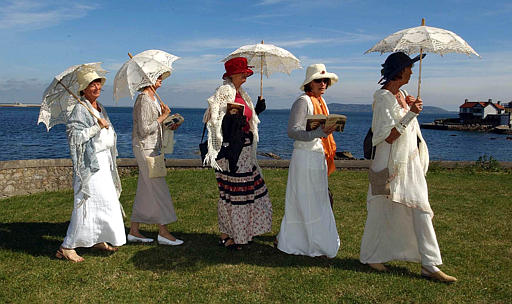
June 16, 1904 is legendary for two events, one of which never really happened. The date exists in reality and in fancy. On that day, the young author James Joyce escorted his bride-to-be, Nora Barnacle, to Ringsend, a village outside Dublin. In a separate iteration of that selfsame day, Leopold Bloom, advertising salesman and Everyman, embarked on the most sublimely banal excursion in modern literature. If Ulysses is an allegory of the modern experience, then it's all the more fitting that we, its readers, commemorate the journey of that novel's hero as though it really happened -- a veritable holiday. What a thing of wonders is our collective memory!
Saturday, June 11, 2011
The Black Spot: Shirley Jackson's "The Lottery"

There are two related myths about history. One concerns the evolution of time, the idea that time is constantly unfolding in advance of some final incarnation, like utopia. The other is that man, who exists in time, is constantly outpacing the primal aggressions and irrational impulses of his prehistoric and uncivilized origins.
Shirley Jackson's haunting tale, "The Lottery," deconstructs these myths, though without the hopeless pessimism we might expect from such a deconstruction.
The story is set in a small, nondescript village during an annual "lottery." Neighboring villages, we learn, have a similar tradition, but some have been doing away with it. While the townsfolk gather in the square to take part in this ritual, a group of boys is piling up stones, as though in preparation for a game of war. The village official who organizes the lottery produces a black wooden box filled with slips of paper, from which every adult male will take several pieces and distribute them to the members of his family. An old man, under whose steely gaze this ceremony has been watched and conducted for generations, remarks that the lottery has always yielded a good crop, a hint of the superstitions underpinning the ceremony. Finally when the slips of paper have been meted out, the townsfolk will open their pursed hands and look inside. On one of these scraps is marked a black circle, betokening an act of brutality and inhumanity that belies the quaintness of this seemingly well-ordered village.
When "The Lottery" was published in 1948, it aroused a violent public reaction. Jackson received hate mail and harsh criticism, readers cancelled their subscriptions to the magazine in which the story was featured (The New Yorker), and in the following years, discussion groups were formed to better understand this bizarre story. In a sharp turn of critical awareness, "The Lottery" has since been integrated into school reading programs, having become an educational rite of passage for many young students.
Though one may not be able to imagine the shock produced by "The Lottery" when it first appeared, who can doubt it? Sneaking into public circulation amidst the growing anxiety of a "cold war," Shirley Jackson's haunting parable was not only a blow to American confidence in its own noble character and mission, but was inimical to the perception of man as innately good and capable of civilization. Earlier in the century, the Anglo-Polish writer, Joseph Conrad, challenged this myth in novels which evoked the barbarism latent in purportedly civilized Western society. The "Lottery" was, by analogy, America's own "Heart of Darkness," and caused its own reverberations.
In one sense, "The Lottery" overturns the hackneyed notion of the innocent and gentle countryside, the pastoral idyll as envisioned by Virgil and many Renaissance poets. But that assessment limits the story and its author's intentions too strictly. Jackson was writing an allegory of the human soul, and she was drawing on the wide span of human history to show that something was deeply wrong, particularly in the light of two devastating world wars. As the story suggests, there is a deep reservoir of irrational impulsivity in human society, a notion that had been gaining currency since the mid-nineteenth century, reinforced in particular by Sigmund Freud, who discovered an underworld of strange and largely unconscious menace lurking beneath genteel Viennese society.
For Jackson, as for Freud, that menace is an atavism of man's primal heritage. History and human enlightenment have failed to eradicate it. We must live with our innate barbarism and suppress it with layers of civilization (albeit to our discontent, as Freud theorized). Yet, like Freud, Jackson seemed to believe that this irrationality could be controlled. While the "lottery" symbolizes the antiquated traditions, rituals, and superstitions that man preserves against his better reason, it fails to hold man in perpetual sway, as seen in its repudiation by other villages. Thus as an allegory of the human soul, "The Lottery" also reflects, if meekly, an optimism about man's inclinations toward freedom and happiness.
Subscribe to:
Posts
(
Atom
)